

Install Mercur
Create a marketplace project with
create-mercur-app, seed it and run the API, admin and vendor panel locally.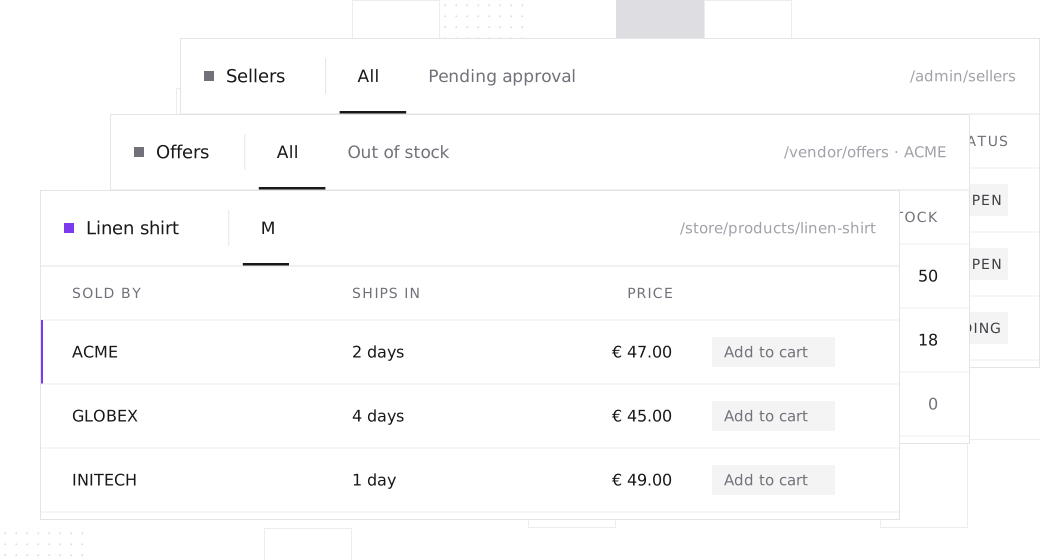
Use cases
Launch a multi-vendor marketplace
Register sellers, approve or suspend them, and give each a team with roles that never leak into another store.
Curate one shared catalog
Keep master products in a single catalog, allowlist which sellers may sell which products, and review every submission and edit before it goes live.
Let sellers compete on the same products
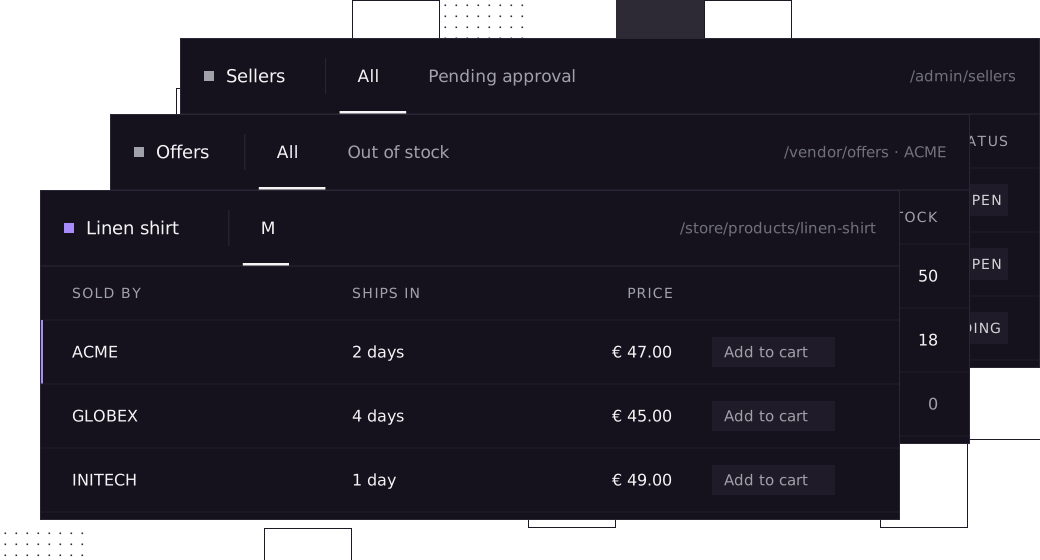
Sellers list offers against master products with their own SKU, price, stock and shipping; shoppers pick the offer, not a duplicate product.
Split checkout, commission and pay out
One payment becomes one order per seller, commission lines are computed per order, and payouts reach each seller’s connected account on a schedule.
What is a standalone marketplace?
A standalone marketplace is a store whose catalog is sold by many sellers rather than by the operator. The operator owns the brand, the storefront and the rules: who may sell, what the catalog looks like, what commission applies. Sellers own their stock, their prices and their fulfillment. The shopper sees one store and pays once; behind it, each seller receives and ships their own part of the order.Why run it on Mercur
Building that on a single-store engine means writing the seller layer yourself: seller accounts and teams, a catalog that is shared rather than owned, a review pipeline for edits, order splitting, commission arithmetic, payouts. Mercur ships those as modules on top of Medusa, so the commerce core is mature from day one and the marketplace layer is yours to extend. You self-host it, you own the source of every block you install, and there is no commission on gross merchandise value.How Mercur does it
- Sellers and teams: the Store module holds seller accounts, their lifecycle (
pending_approval→open→suspended/terminated) and members with per-store roles. - Catalog: master products live in one shared catalog; a product–seller link allowlists who may sell them, and every edit flows through the product change pipeline with an audit trail.
- Offers: an offer is how a seller sells a master product, with offer-scoped price, inventory and shipping profile.
- Orders and money: the Order Group module splits a cart into one order per seller, the Commission module writes commission lines per order, and the Payout module transfers seller earnings through a provider such as Stripe Connect.
Architecture
How the panels, the API and the modules fit together.
Marketplace inside a store
Already running a store such as Magento? Keep it and add sellers to it instead.